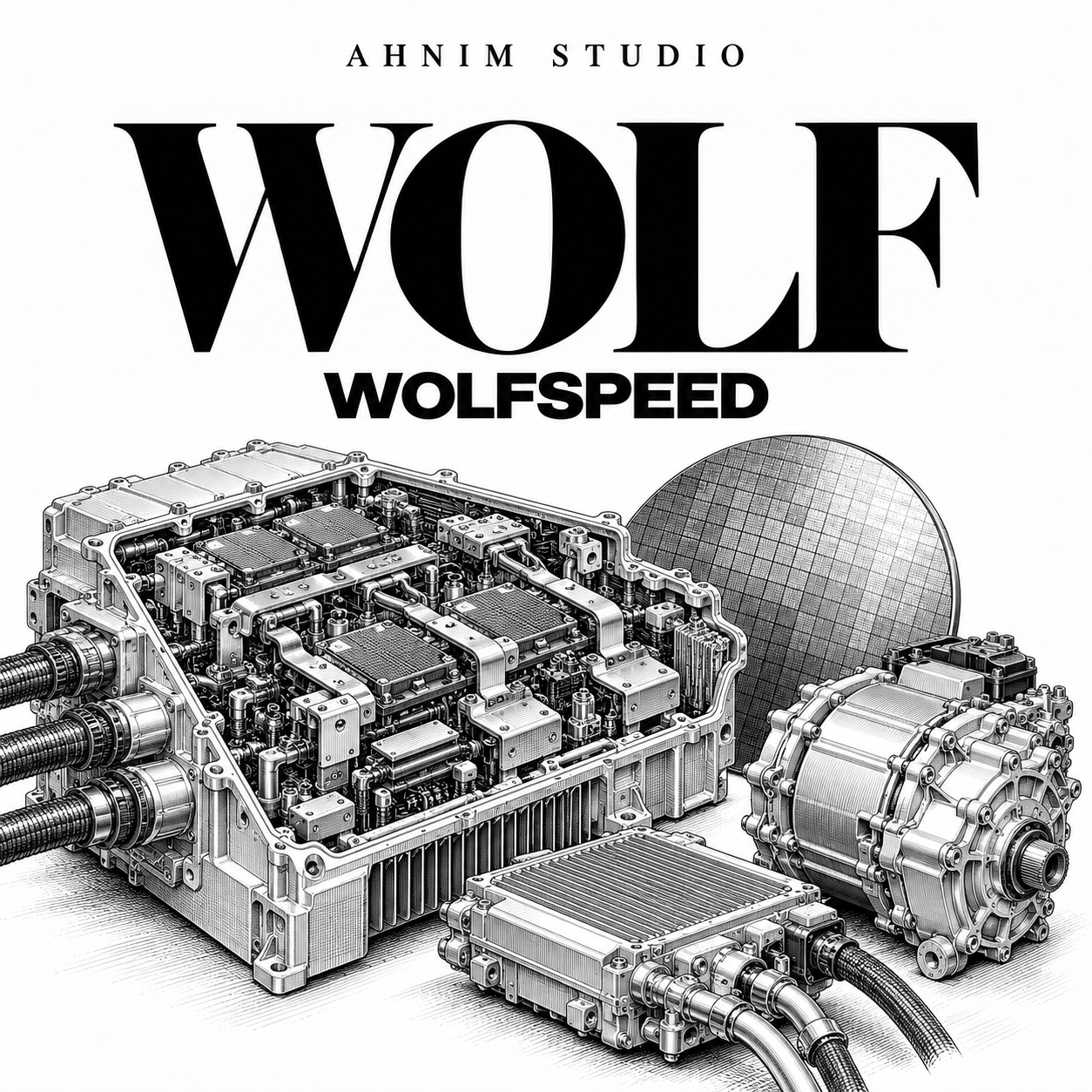
Wolfspeed’s new multiyear silicon-carbide device agreement with BorgWarner is a genuine customer-validation step: the named Tier 1 supplier plans to use Wolfspeed’s 1,200-volt Gen 5 devices in a next-generation 800-volt inverter platform. It is not yet a valuation-changing disclosure. Neither company gave volume, pricing, program timing, minimum-purchase commitments or expected revenue, so we leave our Wolfspeed model unchanged. A separate transparent-SiC launch adds long-term option value, but samples and technical claims are not booked demand.
Three findings
- BorgWarner validates Wolfspeed at the device level, complementing the materials-level evidence in the earlier Infineon 200 mm wafer agreement.
- The missing commercial terms prevent us from converting “multiyear” into a revenue estimate or backlog number.
- The transparent-SiC announcement broadens Wolfspeed’s addressable applications, but the next evidence must be a qualified customer, paid volume or disclosed revenue.
What the two companies actually confirmed
On October 28, 2026, Wolfspeed said it had signed a multiyear agreement to supply silicon-carbide devices for BorgWarner’s next-generation 800 V SiC inverter platform. The release identifies Wolfspeed as a strategic partner, names its 1,200 V technology and says its U.S. manufacturing has fully transitioned to 200 mm wafers.
BorgWarner separately announced on October 29 that it had won a next-generation high-voltage inverter award from a major global automaker. BorgWarner said the award extends an existing customer relationship and described a platform using its latest power-module technology. The timing and product description are consistent with the supply-chain context, but neither company explicitly says that BorgWarner’s October 29 OEM award is the end program covered by Wolfspeed’s October 28 agreement. We therefore treat the BorgWarner award as corroborating market context, not as proof of Wolfspeed’s program volume.
| Disclosure | What is confirmed | What remains undisclosed | AHNIM treatment |
|---|---|---|---|
| BorgWarner device agreement, Oct. 28 | Multiyear supply; 1,200 V Wolfspeed SiC for a next-generation 800 V inverter platform; 200 mm manufacturing | Contract value, unit volume, pricing, start of production, minimum purchase, take-or-pay, exclusivity | Customer and platform validation; no revenue added to the model |
| BorgWarner OEM award, Oct. 29 | High-voltage inverter award for future BEV programs from an unnamed global automaker | Customer, program volume, exact production date, Wolfspeed linkage | Adjacent demand evidence only; not combined with the Wolfspeed agreement |
| Transparent SiC launch, Oct. 29 | Commercial introduction; 200 mm optical-grade substrates advancing; 300 mm in development; samples available | Named customer, price, qualification status, order, capacity, revenue or ramp date | Technology option; no forecast revenue |
The distinction matters. “Multiyear” describes duration, not guaranteed economics. A framework agreement can still produce weak revenue if vehicle volumes are low, pricing is aggressive or the program launches late. Conversely, a modest starting program can become valuable if it qualifies Wolfspeed’s Gen 5 devices for subsequent platforms. The first release does not tell us which outcome is more likely.
Why 1,200 V devices in an 800 V inverter are not contradictory
The platform voltage and device voltage rating describe different layers of the system. An 800 V vehicle architecture needs switching devices with headroom for transients and operating conditions. Wolfspeed’s release specifically says BorgWarner is using 1,200 V SiC technology in the 800 V inverter platform. That is the verified configuration; it should not be rewritten as a 1,200 V vehicle platform.
For Wolfspeed, this is also a more direct device signal than the October 15 Infineon agreement. Infineon’s expansion covers 200 mm SiC wafers, supporting the materials business. BorgWarner’s agreement concerns devices that sit inside a power-electronics platform. Together, the two announcements show demand across two layers of Wolfspeed’s vertical model. They still do not show whether the 200 mm transition is producing positive gross profit.
The revenue test: what would be material?
Wolfspeed reported fiscal 2026 revenue of $665.1 million, including $456.5 million from power products and $208.6 million from materials. Because the BorgWarner agreement has no disclosed value, the table below is a sensitivity—not a forecast. It translates hypothetical annual revenue into a percentage of Wolfspeed’s latest full-year base.
| Hypothetical annual BorgWarner revenue | % of FY2026 power revenue | % of FY2026 total revenue | Interpretation |
|---|---|---|---|
| $4.6 million | 1% | 0.7% | Commercial validation, but unlikely to change the company model alone |
| $22.8 million | 5% | 3.4% | Noticeable device-program contribution if margin and timing are credible |
| $45.7 million | 10% | 6.9% | Material to the power segment, but still requires evidence of profitability and production |
Method: hypothetical annual revenue equals 1%, 5% or 10% of FY2026 power revenue of $456.5 million. The total-company percentages use FY2026 revenue of $665.1 million. Values are rounded to one decimal place. These are AHNIM scenarios, not company guidance or analyst estimates.
The sensitivity also shows why a named customer is not enough. Wolfspeed’s fiscal fourth-quarter GAAP gross margin was negative 25%, and non-GAAP gross margin was negative 20%. A contract that fills underused 200 mm capacity at acceptable yield and pricing can improve absorption; a low-margin contract can add revenue without solving cash burn. We need at least one of three things before changing the earnings path: disclosed program revenue, a segment-level margin inflection, or management commentary that quantifies utilization and yield improvement tied to the new platform.
Transparent SiC is an option, not a second contract
On October 29, Wolfspeed commercially introduced its TSiC transparent silicon-carbide technology for augmented-reality waveguides, quantum-computing research and other optical uses. The company says its optical-grade substrates offer low optical absorption and strong flatness, that it is advancing 200 mm substrates, and that 300 mm technology is in development. The release invites sample requests.
Those are meaningful technical and go-to-market milestones. They are not evidence of a production customer. “Commercial introduction” can mean the material is available for evaluation; it does not disclose a purchase order, qualification completion, capacity commitment or revenue. We assign no near-term revenue to TSiC. The next credible progression is sample → customer qualification → paid pilot → repeat volume → disclosed contribution. Skipping those steps would turn a materials-development announcement into an unsupported financial claim.
Valuation: no change to the conditional $16 base case
Our October 21 core research used a one-year boundary of October 21, 2027 and conditional bear/base/bull values of USD 0 / USD 16 / USD 41. We explicitly kept a firm point target under review because financing, dilution and negative gross margin dominate the equity bridge. The BorgWarner agreement improves the customer-evidence column, but its missing economics do not change FY2029 revenue, margin, net-debt or share-count inputs. We therefore keep the conditional USD 16 base case unchanged.
WOLF closed at USD 24.95 on October 29, 2026. StockAnalysis showed a two-analyst 12-month average target of USD 25, with both analysts at Hold; its data were last updated October 21. Susquehanna reduced its target from USD 30 to USD 25 while reiterating Hold on October 21, before the two new announcements. TD Cowen’s USD 25 Hold initiation dates to August 20. We found no verified analyst target change after the BorgWarner or TSiC releases.
Our USD 16 conditional base is 36% below the USD 25 two-analyst average: the absolute difference of USD 9 divided by USD 25 equals 36%. The gap is not a view that the BorgWarner win lacks strategic value. It reflects our heavier penalty for unquantified financing, dilution and margin execution. The USD 16 base would need to rise if Wolfspeed converts the agreement into disclosed, profitable volume and reduces the equity-risk adjustment; it could fall if the November results show continued negative gross margin without credible utilization progress.
What to check on November 4
Wolfspeed’s fiscal first-quarter 2027 call is scheduled for November 4. The most useful questions are narrow:
- Does management quantify BorgWarner program timing, annualized revenue or minimum commitments?
- Is the agreement already included in fiscal 2027 guidance, or is it a later platform?
- Does Gen 5 production improve Mohawk Valley utilization, yield or device gross margin?
- Are TSiC samples paid, and is any customer in formal qualification?
- Does the company preserve liquidity while funding qualification and the 200 mm ramp?
Until those answers arrive, the investment thesis is strengthened at the customer-validation layer but unchanged at the cash-flow and valuation layers.
Related coverage
- Wolfspeed core research: can 200 mm SiC margins outrun the next capital reset?
- The earlier Infineon 200 mm wafer agreement and its revenue, yield and funding tests
- AHNIM STUDIO research methodology and corrections policy
This analysis is for information and education. It is not investment advice, and the scenario values are conditional estimates rather than promises of market performance.
Sources and original documents
- Wolfspeed, “Wolfspeed Powers the Future of EVs with Multiyear Silicon Carbide Device Agreement,” October 28, 2026: https://www.wolfspeed.com/company/news-events/news/wolfspeed-powers-the-future-of-evs-with-multiyear-silicon-carbide-device-agreement/
- BorgWarner, “BorgWarner Secures High-Voltage Inverter Business Win,” October 29, 2026: https://www.borgwarner.com/newsroom/press-releases/2026/10/29/borgwarner-secures-high-voltage-inverter-business-win
- BorgWarner, Q3 2026 results and new-business awards, October 29, 2026: https://www.borgwarner.com/newsroom/press-releases/2026/10/29/borgwarner-reports-strong-third-quarter-2026-results–increases-2026-adjusted-eps-guidance–announces-9-awards-across-portfolio-to-support-long-term-profitable-growth
- Wolfspeed, “Wolfspeed Commercially Introduces Transparent Silicon Carbide Technology for Augmented Reality and Quantum Computing,” October 29, 2026: https://www.wolfspeed.com/company/news-events/news/wolfspeed-commercially-introduces-transparent-silicon-carbide-technology-for-augmented-reality-and-quantum-computing/
- Wolfspeed Form 10-K for the fiscal year ended June 28, 2026, filed August 20, 2026: https://www.sec.gov/Archives/edgar/data/895419/000089541926000054/wolf-20260628.htm
- Wolfspeed fiscal Q4 2026 results, furnished August 19, 2026: https://www.sec.gov/Archives/edgar/data/895419/000089541926000049/ex991q4-26.htm
- StockAnalysis, WOLF quote and analyst forecast, price as of October 29 and forecast data updated October 21, 2026: https://stockanalysis.com/stocks/wolf/forecast/
Response
[…] Wolfspeed–Infineon contract review preserves what was and was not disclosed at announcement. The October 30 BorgWarner 800 V agreement review adds a named device-platform customer while keeping undisclosed volume, pricing and timing outside […]